 By Happypal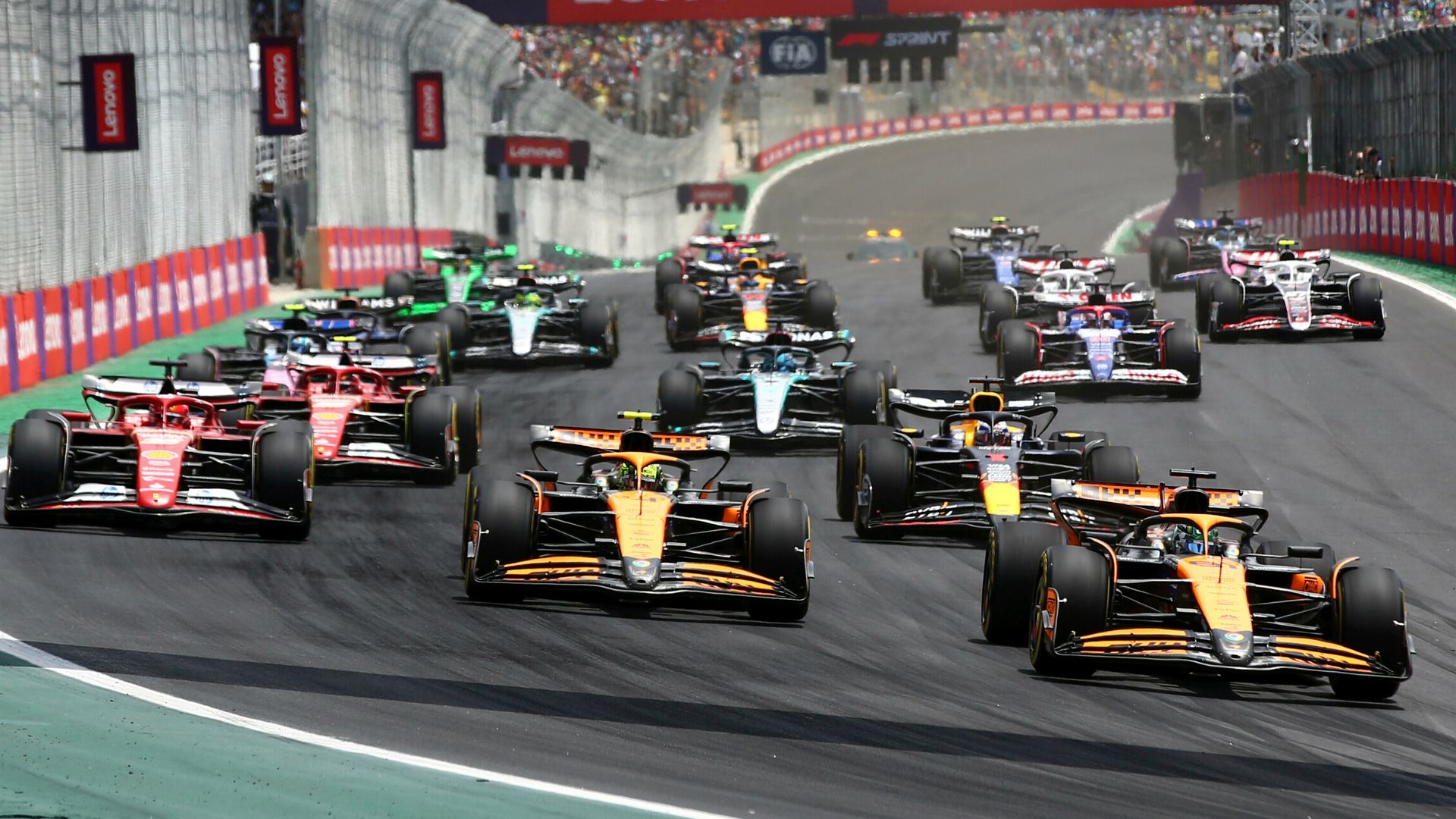
Every Formula 1 season has its defining race — that one weekend where the tension boils over, the title picture shifts, and legends are made. For 2025, that race might just be the Sao Paulo Grand Prix at the iconic Interlagos Circuit.
This year, the Formula 1 championship fight has reached fever pitch. Lando Norris, Oscar Piastri, and Max Verstappen have been trading wins, fastest laps, and bold overtakes all season. The rivalry is intense, the stakes are enormous, and the fans are ready for chaos of the most beautiful kind.
And there’s no place better for it than Brazil’s Interlagos — a circuit where drama doesn’t just happen, it explodes.
🏁 The Stage Is Set: Three Drivers, One Dream
The 2025 F1 title race has unfolded like a thriller. For the first time in over six years, a McLaren driver leads the standings, and the two papaya-colored cars have consistently pushed Red Bull and Verstappen to their limits.
Lando Norris, finally in possession of a car capable of matching Verstappen’s relentless pace, has turned potential into performance. He’s confident, calm under pressure, and laser-focused on delivering McLaren’s first title since 2008.
Alongside him, teammate Oscar Piastri has proven he’s no number two. The young Australian’s fearless racing and near-perfect qualifying form have earned him widespread respect — and more than a few raised eyebrows in the Red Bull camp.
Then there’s Max Verstappen, the reigning world champion, who refuses to give up his throne. Despite setbacks, he remains a threat at every turn, especially on circuits like Interlagos where precision and aggression define champions.
The table couldn’t be set more perfectly: three elite talents, one legendary venue, and 71 laps to shape Formula 1 history.
🇧🇷 Interlagos: The Circuit of Emotion
There’s a reason drivers, teams, and fans revere Interlagos. Officially known as the Autódromo José Carlos Pace, it’s a circuit that combines technical complexity with unpredictable conditions and an atmosphere unmatched anywhere else in the world.
The track layout is short — just over 4.3 km — but brutally demanding. Its undulating nature, high-speed esses, and tricky traction zones test both car and driver in equal measure.
A Track Built for Overtaking
From the iconic Senna S to the Reta Oposta, Interlagos invites wheel-to-wheel action. Drivers who dare to brake late and trust the grip are rewarded with overtakes that often make season highlight reels.
The sweeping middle sector requires rhythm and bravery. Then, as the cars climb toward Juncao and the long uphill drag to the finish line, slipstreams come into play, turning the home straight into an overtaking frenzy.
Add Brazil’s volatile weather — with sudden downpours and temperature swings — and you get a circuit that never delivers the same race twice.
🌧️ The Weather Factor: Rain, Chaos, and Opportunity
If Formula 1 had a word for unpredictability, it would be “Interlagos.” Rain is almost a tradition here — a wildcard that turns every session into a test of instinct.
Over the years, rain has rewritten championship scripts. From Senna’s emotional home victory in 1991 to Hamilton’s title-sealing overtake in 2008, the circuit’s sudden showers have shaped F1 folklore.
Forecasts for this year’s Grand Prix again hint at unsettled conditions. Early predictions suggest a 60% chance of rain during qualifying and possible showers during the race.
That’s enough to give every strategist headaches — and fans goosebumps.
“When it rains at Interlagos, you never know what’s going to happen,” Norris said ahead of the weekend. “It’s the kind of track where you can go from hero to zero in one lap.”
And that’s exactly why fans can’t wait.
🧠 Strategy Wars: Tyres, Timing, and Tension
The Brazilian GP rarely rewards conservative strategy. It’s a race where timing — pit stops, tyre calls, and safety car gambles — can decide everything.
With the 2025 Pirelli tyre compounds designed to degrade faster under heavy loads, teams face a strategic minefield. Do they risk an early undercut? Do they stretch for a one-stop? Or do they prepare for the inevitable chaos a safety car might bring?
Interlagos’ short pit lane encourages creative calls, often resulting in split strategies even within the same team. McLaren and Red Bull are expected to approach it differently — McLaren focusing on tyre management, Red Bull relying on Verstappen’s aggression and data-driven precision.
A strategist’s dream. A fan’s spectacle.
🧱 McLaren’s Rise: Norris and Piastri Rewrite the Script
McLaren’s 2025 season has been nothing short of spectacular. After years in Red Bull’s shadow, the Woking outfit’s comeback has felt both inevitable and deeply emotional.
The turning point came mid-season, when McLaren introduced a major aerodynamic upgrade that transformed its balance through medium-speed corners. From that moment, Norris and Piastri became genuine title threats.
Team principal Andrea Stella has orchestrated the transformation with quiet authority. His calm leadership and data-first philosophy have built a team of belief and unity — a key ingredient for any title fight.
“We believe in our drivers,” Stella said. “Both are world-class. Both can win. And both are pushing us to new levels.”
That harmony could prove decisive in Brazil, where teamwork often trumps individual ambition — at least until the final laps.
⚔️ Red Bull’s Resilience: Verstappen Refuses to Yield
Despite a season of frustration, Max Verstappen remains the most dangerous man on the grid. Red Bull’s early dominance may have waned, but their championship experience is invaluable.
The RB21’s strength lies in straight-line speed and mechanical traction — two assets that make Interlagos a comfortable hunting ground for Verstappen. He’s a three-time winner in Brazil and thrives in mixed conditions.
Even when the odds seem against him, Verstappen finds a way to strike back. His rivals know it, too.
“You can never count Max out,” Piastri said recently. “He’s the kind of driver who can turn a P5 start into a win within 10 laps.”
Red Bull’s pit crew also remains the benchmark. Their average stop time this season is a record-breaking 1.82 seconds, a stat that can swing the balance when every tenth counts.
🧩 The Ferrari and Mercedes Factor
While the title may seem a three-way contest, Ferrari and Mercedes aren’t far behind.
Ferrari’s Charles Leclerc and Carlos Sainz have consistently snatched podiums, and their upgraded power unit has narrowed the straight-line deficit. Leclerc, in particular, has fond memories of Brazil, often thriving under pressure.
Mercedes, meanwhile, remain unpredictable. Their car’s performance fluctuates wildly from circuit to circuit, but Lewis Hamilton — a record-equalling three-time winner at Interlagos — always saves something special for Brazil.
Hamilton’s relationship with Brazil runs deep; the nation officially made him an honorary citizen in 2022. A victory here would not only fuel nostalgia but also inject late-season excitement.
💥 Interlagos Through the Years: A Theatre of Champions
Interlagos has hosted some of the most emotional and chaotic races in F1 history.
2008 – Hamilton’s Last-Lap Glory
The race that defined a generation. Lewis Hamilton clinched his first world title on the final corner, overtaking Timo Glock in wet conditions while Ferrari’s pit wall celebrated too early.
2012 – Vettel’s Redemption
Sebastian Vettel recovered from a first-lap collision to seal his third consecutive world championship in one of F1’s most dramatic finales.
2016 – Verstappen’s Wet Weather Masterclass
A teenage Max Verstappen stunned the world with fearless wet-weather overtakes, sliding past veterans like Alonso and Raikkonen as if he were born for the chaos.
Every time F1 returns, the circuit seems to write a new chapter. Fans arrive expecting drama — and leave with memories that last decades.
🧮 The Title Math: How It Could Swing
With just a few races remaining, the points gap between Norris, Verstappen, and Piastri sits within 25 points — a single race swing.
- Norris: 282 pts
- Verstappen: 276 pts
- Piastri: 268 pts
In Brazil, a victory (worth 25 points plus the potential 1 for fastest lap) could catapult any of them to the top heading into the season’s penultimate race in Las Vegas.
If rain intervenes or if reliability issues emerge — both very real possibilities — the entire leaderboard could reshuffle overnight.
It’s this mathematical tension that makes Interlagos irresistible.
🔊 The Sound of Brazil: Fans, Passion, and Chaos
Few crowds bring energy like Brazilian fans. They don’t just watch Formula 1 — they live it. From dawn to dusk, grandstands pulse with samba rhythms, drums, and chants of “Senna! Senna!”
The emotional connection between Brazil and motorsport runs deep. The late Ayrton Senna remains an immortal figure, and every driver who wins here feels that presence.
“There’s something magical about racing in Brazil,” Norris said. “You feel the history, the passion, the noise — it gives you extra speed.”
Expect fireworks, flares, and flags. Expect Interlagos to shake when the lights go out.
⚙️ Car Setup Challenges
Interlagos’ mix of corners and altitudes demands a finely balanced setup. Teams must juggle between high downforce for sector 2 and low drag for the uphill straight.
Brake temperatures are another concern; drivers approach corners like Descida do Lago and Juncao at extreme speeds, with heavy deceleration zones testing both machinery and reflexes.
Cooling is also tricky due to the thin air at 800 meters elevation. That can affect turbo performance and energy recovery — crucial in the hybrid era.
“Interlagos exposes weaknesses,” said Red Bull’s chief engineer. “If your car isn’t balanced, you’ll find out within three laps.”
🧠 Mind Games and Momentum
As the pressure builds, psychological strength becomes as valuable as horsepower. Norris and Piastri, both young and still learning the art of title pressure, now face Verstappen — a man who has mastered the championship grind.
McLaren’s internal harmony has been remarkable, but cracks could form if the stakes intensify. The team insists both drivers are free to race, but Brazil might test that policy.
Red Bull, conversely, thrives in this environment. Their entire culture is built on fighting under fire. For Verstappen, chasing is almost more comfortable than leading.
“When you’re the hunter, everything feels simpler,” Verstappen told reporters. “All I have to do is drive fast and enjoy it.”
A chilling reminder that Max is never out of the fight.
🧭 Predictions: What Might Happen in Brazil
If the weather stays dry, Interlagos will likely favour the McLarens, whose traction and mid-corner speed suit the track’s flowing rhythm. Norris has the consistency; Piastri the raw pace. Expect a McLaren front row.
If rain hits, Verstappen becomes the immediate favourite. His car control in wet conditions remains unmatched, and Red Bull’s setup flexibility could hand him an advantage.
Dark horses? Ferrari could spring a surprise through clever tyre calls, while Mercedes might capitalize on chaos.
Ultimately, the most likely scenario is a three-way showdown — a tactical battle that could come down to the final laps, perhaps even the final corner.
🏆 Why Brazil Still Matters So Much
In modern Formula 1, where technology often overshadows emotion, Interlagos reminds us why people fell in love with racing in the first place.
It’s the unpredictability.
The sound of 20 cars charging up the hill.
The rain-soaked chaos that levels giants and heroes alike.
Brazil is where speed meets spirit — and where champions are made, sometimes broken, always remembered.
As the lights go out, the only certainty is uncertainty. Norris wants his title statement, Piastri wants validation, and Verstappen wants revenge.
Interlagos will decide who wants it most.
🏁 More from 9jazic Sports
- Norris the New Favourite in F1’s Title Race as Crunch Time Looms
- Best vs Best: The NFL Makes Its Berlin Debut
- Xhaka Strike Denies Everton Win After Ndiaye Stunner as Sunderland Move Fourth
