 By Happypal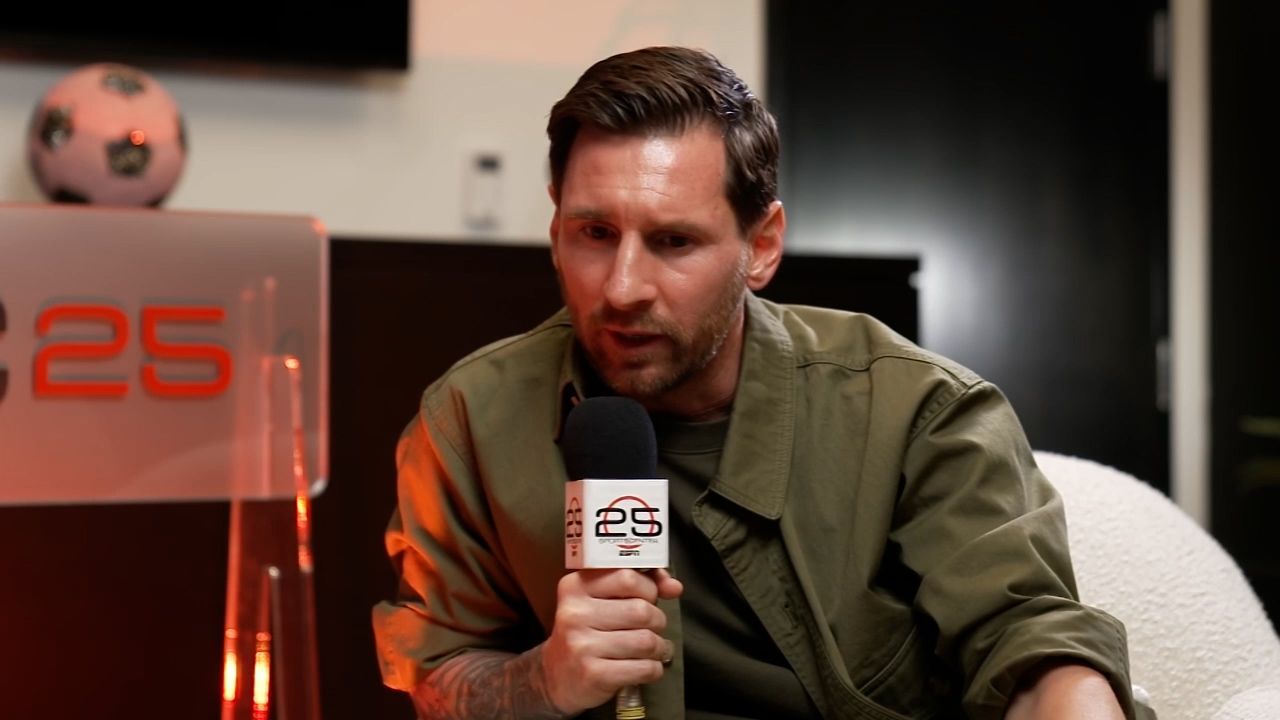
FORT LAUDERDALE, Florida — The Florida sun, softer now in the late afternoon, filters through the blinds of a quiet room at Inter Miami’s training facility. There is no roar of the crowd here, no dizzying whirl of cameras. Just a man in a simple training kit, a bottle of water, and a lifetime of footballing history resting comfortably on his shoulders. This is Lionel Messi now: a global icon in a subtropical calm, yet one whose gaze remains fixed on a distant, burning horizon—the 2026 FIFA World Cup.
In an exclusive, wide-ranging interview with ESPN, Messi, now 36 but with the quiet fire of a teenager who still dreams, has opened a window into his soul. He speaks of a desire that borders on obsession: to once again wear the captain’s armband and lead Argentina’s title defense in North America. He dissects, with a tactician’s reverence, the genius of coach Lionel Scaloni and the foundational lessons of Pep Guardiola. He reflects on his seismic move to Inter Miami, not as a retirement, but as a new chapter of a career still being written.
This is more than an interview. It is a manifesto of intent from a player who has won everything, yet still wants more. It is a roadmap to the next three years, a psychological blueprint of a champion who sees the ultimate challenge not in winning a World Cup, but in defending it.
Part I: “The Feeling is Different” – The Weight of the Crown and the 2026 Dream
The Copa América victory in the summer of 2024 solidified an era of Argentine dominance. Yet, for Messi, the afterglow of triumph is already mingling with the shadow of the next colossal challenge.
“To go to another World Cup as champions… the feeling is completely different,” Messi admits, his voice measured. “In Qatar, we went with the dream, with the hope, but also with the pain of near-misses. Now, we would go with the title on our chests. Everyone wants to beat the champion. The pressure changes. But so does the motivation.”
This admission is profound. The 2022 campaign in Qatar was a narrative of liberation—freeing themselves and their legend from the burden of history. The 2026 campaign, should he be there, would be one of preservation. It is a challenge only a select few nations have ever faced: defending the World Cup. The last to do it was Brazil in 1962. The mental and physical toll is immense.
Messi, however, frames it not as a burden, but as a privilege. “After achieving what we did in Qatar, you might think the hunger decreases. It’s the opposite. You want to feel that again. You want to keep that group together, fighting for the same goal. To have the chance to do it in 2026, in front of incredible crowds in the United States, with so many Argentines living there… it’s a huge motivation for me.”
His commitment is conditional but clear. He will not go as a ceremonial figure. “I will only be there if I am physically at the level to compete and to help the team. If I am just another passenger, I will not go. I owe that to the shirt, to Scaloni, and to my teammates.” This is the essence of Messi’s leadership: an unwavering standard, applied first and foremost to himself.
Part II: The Architect and The Professor – Scaloni’s Wisdom, Guardiola’s Imprint
A significant portion of Messi’s reflection is devoted to two master builders: the man who orchestrated his crowning glory, and the man who forged his professional soul.
On Lionel Scaloni: The Quiet Revolutionary
Messi’s praise for Scaloni is effusive and deeply personal. “What Lio [Scaloni] has achieved is something nobody saw coming, maybe not even him at the start,” Messi says with a smile. “He wasn’t a ‘big name’ coach, but he had two things: a deep love for the national team, and a clear, brave idea.”
He details Scaloni’s genius not in complex tactical jargon, but in human terms. “He built a family. He made every player, from the starter to the last on the bench, feel essential. He listened. After the defeat to Saudi Arabia [in Qatar 2022], the world was falling on us. He was calm. He showed us videos, not just of mistakes, but of how we could break them down. He gave us peace and conviction at the same time.”
Messi highlights Scaloni’s flexibility—the shift from a 4-4-2 to a 3-5-2 in the middle of the World Cup knockout stages—as a mark of courage. “He is not stubborn. He sees the game, he talks with us, and he adapts. For a player, that trust is everything. He made us believe we could solve any problem on the pitch.”
On Pep Guardiola: The Foundational Blueprint
When the conversation turns to Pep Guardiola, Messi’s tone shifts to one of pure, academic reverence. “For me, he is one of the best, if not the best, ever,” he states unequivocally. “What he did at Barcelona, what he continues to do, is to play football in a way that seems from another planet.”
He connects Guardiola’s teachings directly to Argentina’s success. “My understanding of space, of movement, of when to press… so much of that comes from my time with Pep. Scaloni’s ideas have echoes of that. It’s about control, but not for control’s sake—control to attack, to suffocate. Guardiola is a genius because he sees things three passes before anyone else.”
This link creates a fascinating intellectual lineage: Guardiola’s positional play philosophy, absorbed by a young Messi, now manifesting in Scaloni’s tailored system for the Argentine national team. Messi is the living conduit between these two footballing minds.
Part III: The Miami Project – Not a Sunset, But a New Dawn
The move to Inter Miami in July 2023 sent shockwaves through the sport. Many viewed it as the beginning of a leisurely retirement tour. Messi’s words and his on-field performances have fiercely contradicted that narrative.
“It was a conscious, sporting decision,” he insists. “I had other, more ‘traditional’ offers. But I liked the project here. The challenge of helping build something big in a country where soccer is growing so fast. To live here with my family, and to compete.”
He speaks passionately about his role as more than just a player. “I am here to help my teammates grow, to raise the level of the league, to win. The Leagues Cup was important because it showed what we can do. But I want more. I want to fight for the MLS Cup, to leave this club in a place where it can keep competing for everything after I’m gone.”
He addresses the physical challenge head-on. “The travel is long, the weather is different, the matches are physical. It’s a different kind of competition. But it keeps me sharp, it keeps me hungry. Playing consistently, feeling important, is the best preparation I can have for anything, including the national team.”
Messi in Miami is not a diminished force; he is a transplanted one, with his competitive ecosystem deliberately altered to sustain his flame for the battles he still cherishes most.
Part IV: The Bridge to 2026 – The Physical and Psychological Marathon
The three-year gap between World Cups is both a gift and a gauntlet. For an aging superstar, it is a marathon of preservation.
The Physical Calculus: Messi acknowledges the plan is meticulous. His load at Inter Miami is managed with one eye on the Argentine calendar. The Copa América victory provides a qualification safety net, allowing for selective participation in friendlies and qualifiers. The focus is on peak condition for the summer of 2026.
The Generational Handoff: A key subtext is Messi’s role in transitioning the team. He speaks with pride about the emergence of players like Julián Álvarez, Alexis Mac Allister, and Enzo Fernández. “The team is in great hands. These young players have already won the biggest thing. My role, if I am there, is to help guide, to share experience, but on the pitch they don’t need much help. They are fantastic.”
The Historic Quest: The chance to defend the title, and potentially to win a record-extending third World Cup (having played in five tournaments), is a historical lure that clearly drives him. He downplays personal legacy, but the opportunity to separate himself even further from the pantheon is an unspoken motivator.
Part V: The Shadow of Barcelona and the Nature of Legacy
While the interview focuses on the future, the past is never far. He speaks of Barcelona with enduring affection but a firm acceptance that that chapter is closed. His legacy, he suggests, is no longer something to be built, but to be lived.
“I am at peace,” he says, a phrase he repeats. “I enjoyed every moment at Barcelona, I gave everything. Now I am enjoying a new challenge, and I am still enjoying the national team like I did when I was a boy. The day I stop enjoying it, I will stop. But that day is not today.”
His legacy is now active, dynamic. It is in every pass at DRV PNK Stadium, in every hug with a young Argentine teammate, in every piece of advice he gives. It is no longer a statue to be unveiled, but a garden he is still tending.
Conclusion: The Unfinished Man
Sitting in that quiet Florida room, Lionel Messi presents a portrait of a profoundly complete, yet fundamentally unfinished, competitor. He has the serenity of a man who has conquered his world, but the eyes of one who has spotted a new peak.
He is not chasing ghosts or records for their own sake. He is driven by a purer, simpler engine: the love of the fight, the bond of the team, and the relentless pursuit of a feeling—that feeling of final whistles in Lusail, of confetti sticking to sweat-drenched hair, of a nation’s joy flowing through him.
The 2026 World Cup is not a destiny he demands, but a destination he desires. It is a challenge that requires him to be, once more, the best version of himself. For Lionel Messi, that has always been the only point. The symphony he began as a tiny boy in Rosario is not reaching its coda; it is building to a new, unexpected, and breathtaking movement. And he alone holds the baton.
@9jazicSPORT ⚽