 By
By 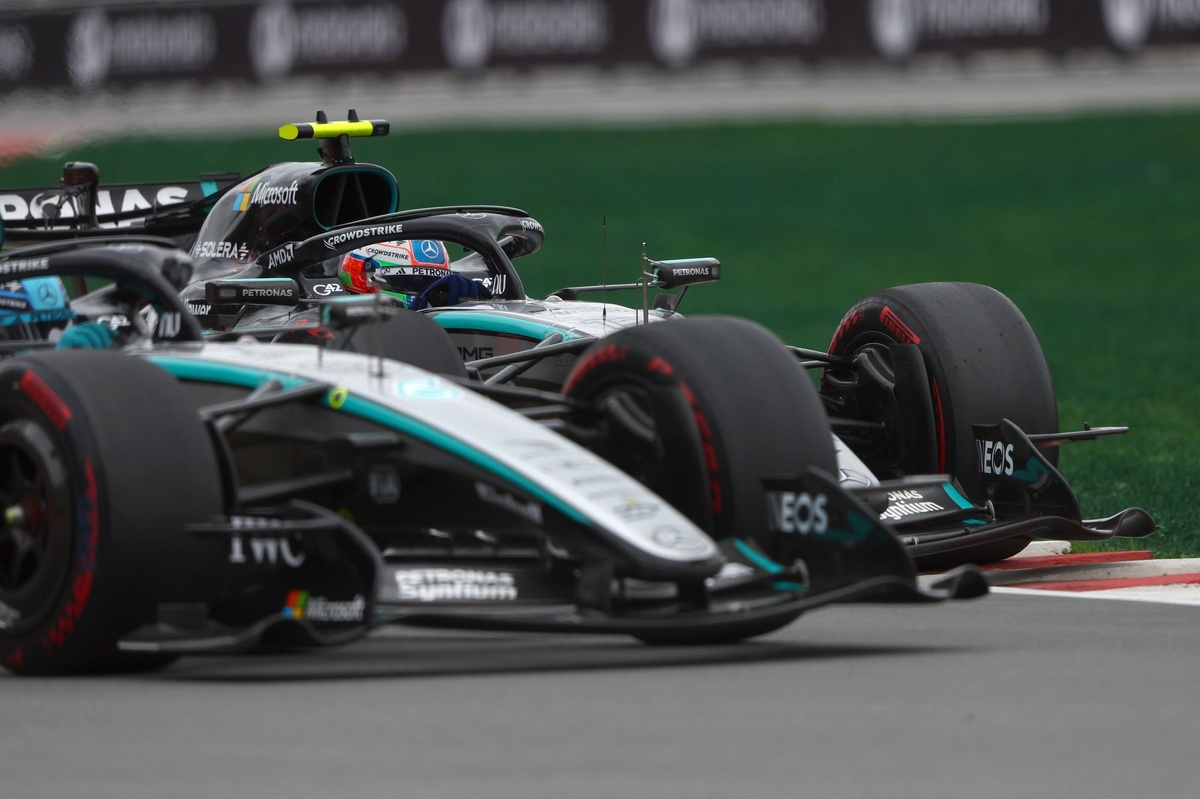

Formula 1 drivers and team orders have a long and disagreeable history, especially when those drivers are in the heat of the world championship battle.
You have to go back to the 1950s to find a properly gentlemanly resolution to a title fight involving two teammates. And even then the famous example of Peter Collins handing his Ferrari over to Juan Manuel Fangio in the 1956 Italian Grand Prix is more complicated than it might appear: not only were the points mathematics more strongly in Fangio’s favour, Collins firmly believed 1957 would be his year.
This, of course, did not come to pass. The lesson here for all F1 drivers is that you have to seize the moment.
43 points separate Mercedes teammates Kimi Antonelli and George Russell at the head of the field after five of what may or may not be 22 rounds of the 2026 season. Less than a quarter of the way through and yet they have already clashed – if relatively gently – on track, stoking historic memories of teammates whose relationships have combusted messily in the fire of the championship battle.
“You can’t really put a leash on a driver that is fighting for wins and championships”
Kimi Antonelli
For Mercedes and its boss, Toto Wolff, those memories are very fresh – the increasingly uncivil war between Lewis Hamilton and Nico Rosberg defined its first three seasons of dominance under F1’s hybrid power unit era. After Russell and Antonelli banged wheels during the Canadian Grand Prix weekend two weeks ago, it was clear there would have to be some kind of intervention from above.
The question was how Mercedes would manage this evolving scenario – and how the laudable principle of “let them race” might survive the practical necessities of securing a constructors’ championship worth hundreds of millions of dollars.
“Basically we had a discussion after the race weekend, actually we had one a couple of days ago before coming here, and we had a chat,” Antonelli told media including Motorsport.com ahead of the Monaco GP weekend.
“We reviewed all the episodes of the Canada race, and the end of the discussion was, ‘You can race each other freely, as long as there’s respect, and as long as you don’t put yourself in situations that could damage one of you or both of you.’

Antonelli and Russell’s battle in Canada came close to eliminating both cars from the race
Photo by: James Sutton / LAT Images via Getty Images
“You know, the team never wants to put any rules. Understandably they want both cars to finish and to get as many points as possible for the team, and that is very well in our minds as well – we race for ourselves, because we want to be the best, we want to win, but we also race for the team, because we want to reward the 2,000-plus people who work back in Brackley and Brixworth.
“We were aware, and for sure, we’re going to keep racing each other, like we did in Canada – of course, a bit more smartly – but definitely the team wants us to race freely. Because it’s also the way to be – you can’t really put a leash on a driver that is fighting for wins and championships.
“You can’t really tell him ‘Oh, just sit back’. The team wants us to race.”
Again, though, the question is whether this noble undertaking can survive the circumstances of a race. One specific instance came in the Canadian Grand Prix where Antonelli got a run on Russell on the outside into Turn 1, only to be ushered off onto the grass.
At the time, Antonelli was furious, and took to the radio not only to complain to the team about Russell’s conduct, but also to lobby the stewards to examine the incident.
But this complaint, albeit in the heat of the moment, was predicated on a misunderstanding of the FIA’s driving etiquette guidelines. When attempting an overtake on the inside, a driver is entitled to “racing room” if their front axle line is alongside the mirror of the car they are trying to pass; on the outside the bar is much higher.
It was a clever, if brusque piece of defence by Russell.
And regardless of what drivers say in public after the fact, what they say in the heat of the moment is often more revealing of tensions behind the scenes – as are images of Wolff studying the TVs in the garage while trying to maintain a poker face, not always effectively.
Fundamentally the drivers have to be left to get on with it after those basic ground rules – don’t take each other out – are established. They cannot micromanage a race live, given the broadcast of team radio renders such interventions damagingly public.
“It was left that we have to be trusted,” said Russell in Monaco.
“This is what we do. We’re drivers, we push ourselves to the limit every single lap.
“And when we race with one another, you push each other to the limits as well. Of course, when you’re sitting on the pit wall like Toto, of course it’s so stressful and tense – because you can’t control what is about to happen and you want to be able to control it.
“But ultimately, we have to be trusted and we are trusted, and that’s how it’s been left. So, yeah, we’ll continue fighting hard. We know the boundaries with one another.”
We want your opinion!
What would you like to see on Motorsport.com?
Take our 5 minute survey.
– The Motorsport.com Team
Share Or Save This Story
What yachts do F1 drivers own as luxury vessels descend on the Monaco GP?
 Happypal